Questions that would probably be asked frequently
CLUB WHERE, WHEN, WHAT- When and where do you meet?
- Do I have to register or call before I come to club?
- I'm not feeling well, can I still attend?
- How do I clean my SCRABBLE equipment?
- How can I take the BUS to club?
- My 12-year-old likes SCRABBLE®; is there an age limit?
- Is there food available? Can I bring my dinner?
- Do you have a policy on cell phones?
- Do I need to bring my own board?
- What are those weird timer things?
- Do I need to bring Score Sheets?
- How long is each game played for?
- How do you determine who plays each other?
- How many games may we play in one evening?
- Is it still $10 if I play fewer than 4 games?
- I can't make it to Thursday club. Where else can I play?
- What's the "Bingo Bonus"? What's the "Category word"? Are there other prizes?
- What are "blue cards" and "white cards"?
- I think I might get thrashed if I attended your club for the first time. Help?
- What are the Club Stats?
- Do you people have an organizer or director or something?
- Can you tell me some Club History?
- What are all the acceptable 2-letter words?
- What word source do you use?
- Tell me about the new word list (OWL3)?
- Tell me about the new word list (OWL2)?
- OSPD4, OSPD3, TWL98, OWL, OWL2, LWL, SOWPODS--what are all these?
- What if my opponent plays something that I think is not really a word?
- What is a Word Judge? How can I become one?
- What Rules do you follow?
- NSA v. NASPA : What's the deal?
- What is WGPO?
- You mentioned National SCRABBLE® Association. Do I need to become a member?
- What about tournaments?
- How do ratings work?
- What's the difference between a Local Club Tournament and an Open Rated Tournament?
- What is a Director? How can I become a Director?
- Where can I play SCRABBLE® online? What is ISC?
- How can I talk with other Seattle Club players?
- How can I talk with other SCRABBLE® players? What is CGP?
* Please silence your cell phone *
CLUB WHERE, WHEN, WHAT...
When and where do you meet?
Since October 2024, the Seattle Scrabble Club has been meeting every Thursday at :
Woodland Park Lawn Bowling Clubhouse
6150 Whitman Ave N
Seattle, WA 98103
Larger Google Map of WPLBCAll levels are welcome, from beginner to expert. The first time is always free, but subsequent visits require a $10 fee, collected during the first game. Games begin at 6pm, but you should try to get there by 5:55pm your first time--don't be late!
The WPLBC is just east of Aurora Ave N, between Woodland Park Zoo and Green Lake.
Note that some navigation apps cannot find the clubhouse, so you can check the WPLBC website for maps and directions. Their website does not include directions for bus riders, but the Rapid Ride E line stops nearby, just off Aurora Ave N, at N. 65th St and Woodland Pl. N. Bicyclists can use the Green Lake bike path or West Green Lake Way North.Do I have to register or call before I come to club?
No, just show up when you want to play. Try to arrive by 5:55pm your first time, so we can explain how things work. [Note: you can start with the second game, in which case you should try to arrive by 6:45pm]
On the rare occasion that we cancel club (due to weather or holiday), we'll post a notice on this website and/or the club's Facebook page.
[ Return to Top ]

I'm not feeling well, can I still attend?
Please don't.
Players are encouraged to wear masks and get updated vaccinations for COVID, flu, etc. Please don't come to club if you are not feeling well.
If you are feeling sick (especially if you are sneezing, coughing, or running a fever), please STAY HOME!
Playing Scrabble means touching tiles that are shared and touched by others, so it's a very good way to spread a cold or virus. No one else wants your cold or flu, so please stay home and take care of yourself and come back when you are feeling better.
Even when you are feeling fine, please remember to WASH YOUR HANDS with soap and water.
If you sneeze or cough, please do so into the crook of your elbow - not into your hand. But if you do accidentally sneeze or cough into your hand, please go wash your hands.
Thank you.
How do I clean my SCRABBLE equipment?
SCRABBLE tiles pick up dirt and odors, so they should be cleaned on a regular basis (at least once a year). You need to wash the tiles and the tile bag. You don't need any special equipment, just soap and water.
- make sure there is a strainer covering the sink drain (so you don't lose any tiles down the drain)
- fill a large bowl (or the basin of your sink) with warm soapy water (I just use dish soap)
- add tiles to the soapy water and stir them around with your hands for 1-2 minutes
- drain soapy water and rinse several times with warm water until it runs clear
- spread tiles out on a towel and let dry
- While the tiles are drying, wash your tile bag. You can wash it by hand or put it through the washing machine and dryer (depending on the material - cotton bags should be fine in the machine).
How can I take the BUS to club?
From downtown Seattle:
The WPLBC is just east of Aurora Ave N, between Woodland Park Zoo and Green Lake. Note that some navigation apps cannot find the clubhouse, so you can check the WPLBC website for maps and directions. Their website does not include directions for bus riders, but the Rapid Ride E line stops nearby, just off Aurora Ave N, at N. 65th St and Woodland Pl. N. Bicyclists can use the Green Lake bike path or West Green Lake Way North.
My 12-year-old likes SCRABBLE®; is there an age limit?
Players of all ages and abilities are welcome at club, but be aware that all players are expected to keep score for themselves, play by the rules, and use a clock (game timer). Also, the official word list is NOT abridged, so some words that may be "offensive" are acceptable for play (see expurgated word list for words acceptable for club & tournament play that are not listed in the OSPD).
Please use your own judgment to determine if your child is mature enough for this environment. Children under 15 must be accompanied by an adult.
Is there food available? Can I bring my dinner?
Since club starts at 6pm and goes until 10pm, most folks eat dinner beforehand (or wait until afterwards to eat). You can bring food to eat, but you should plan to eat between games since there isn't a lot of extra room at the tables when you are playing, and no one wants food on their equipment.
NOTE: You are required to take your trash and recycling away at the end of the evening, so if you bring food please be prepared to clean up after yourself. See news link: Please pack out your trash and recycling.
If you are looking to purchase food, the closest place is Campus Teriyaki, at 41st & Roosevelt, about a block and a half away. There is no marked crosswalk across Roosevelt at 41st, so be careful crossing (or go up to 42nd where there is a light). There are many other food options further away, along 45th or University Way.
Do you have a policy on cell phones?
We ask that you
TURN YOUR CELL PHONE RINGER OFF when you enter our club space and do not answer or place phone calls in the playing room. If you need to make a call or answer the phone, please step outside. No one wants to hear your phone ring, or your telephone conversation.You are not allowed to use electronic devices (including cell phones, bluetooth earpieces, google glass, etc.) during games. That includes checking for text messages, email, etc. If you are expecting an urgent call or message, please let your opponent know before the game starts and make sure your phone ringer is OFF.
[ Return to Top ]
Do I need to bring my own board?
No. Deluxe boards and Protiles are always welcome though, if you have them to bring.
Interested in upgrading your equipment? Check our Links Page for a list of people who sell custom boards, Protiles, clocks, tile bags, etc.
What are those weird timer things sitting on the tables with the board, racks and tile bags?
Those are timers. There are several makes and models, from analog chess clocks to electronic timers made exclusively for SCRABBLE® play. It takes a while to get used to them. When you have placed your word on the board and announced your score, you hit your timer to indicate the end of your turn. The opponent's timer and turn are started.
Interested in upgrading your equipment? Check our Links Page for a list of equipment vendors.
Do I need to bring Score Sheets?
No. Score sheets are provided at club. However, we do recommend you bring your preferred writing instrument.
There are lots of different score sheets available, yet some folks get by using just a blank piece of paper. If you want to track tiles or record your racks, having a pre-printed score sheet is a big help. Experiment with different ones, pick one you like, or design your own. Whichever you choose--once you've become accustomed to one design you should see your game improve because tracking and scoring will become second nature.
You can print out your own copies of the Club Score Sheets if you wish. We provide two versions: Horizontal Score Sheet [pdf] and Vertical Score Sheet [pdf]. They are formatted 2 games per page (print double-sided for 4 games per sheet). For links to lots more Score Sheets, check the Forms section on our Links page. Note: some folks print out a few hundred score sheets and have them bound into a book for easy transportation and organization.
[ Return to Top ]
How long is each game played for?
Usually a little under an hour. Each player in a two-player game is allotted twenty-five minutes to complete all moves. Players are penalized ten points for going overtime up to one minute; every minute after that an additional ten points. How long games really last are up to you and your opponent. Someone "doubling up" by taking two opponents on at once is untimed, while the opponents are given their typical twenty-five minute allotment (although this rarely happens anymore--now that we have one person sit out if we are uneven)
How do you determine who plays each other?
Since May 14th, 2019, we've been using a new method for pairing the first round of play: choosing opponents at random instead of players picking their own opponents. Why the change? Players arriving before 6pm have to sit out when we are uneven - and we are trying to avoid having this happen to the same player(s) repeatedly. This will also randomize the first pairings instead of the same folks playing each other every week.
How does it work? Each player will draw a tile out of a special bag (with just tiles A - Z) and will be paired using that instead of choosing their own opponent for the first round.
Note: this only applies to the pairing of the first round; subsequent rounds will be paired as usual (using standings for the evening, while avoiding repeats, etc.) Also, there will be an exception for new players: the director will continue to choose opponents for new players.
Steps:
- Players set up tables and boards as usual (but DO NOT select an opponent and do not start a game).
- Each player fills out a card with their name and places it in the red basket
- At 5:55pm, the director will start the drawing process (this should give us enough time to get everything set up and most players will have arrived)
- Each player will draw a tile out of the special bag (orange, with just one each of A, B, ... Z).
- After all players have drawn a tile, players will be paired in alphabetical order by drawn tile with the first two closest to A, then the next pair, and so on.
- If we are uneven, the Director will consult the Players Sitting out list to see who is next to sit out ( if there is a tie, the player with the letter closest to Z will sit out). The player that sits out will be recorded as a regular sit out in the folder.
- Players find their opponents and games start by 6:00pm
- Player arriving after games have commenced will still have to sit out (unless we were uneven, of course)
Up to how many games may we play in one evening?
If you limited yourself to one opponent at a time, up to four.
Is it still $10 if I play fewer than 4 games?
Yes, it's $10 even if you just play one game. The costs for the club are the same whether you play just one game or all four--you still use a score card, a score sheet, and use the room. If we lowered the rate for players who only play 1 or 2 games, we'd have to raise it for the rest, and that wouldn't be fair. Remember, it's still a bargain.
Starting August 2018, Club director and statistician will pay a discounted rate of $4 (the had been paying nothing for several years).
[ Return to Top ]
I can't make it to Thursday club. Where else can I play?
If you can't make it to Thursday Club, there are some other SCRABBLE® get-togethers around the area. Some attract tournament-style players, and others are more laid-back. Take your pick!
West Seattle Scrabble Club meets 2nd and 4th Mondays at The Bridge, 6301 California Ave SW, Seattle, 98136 (note: this is a new location, starting in December 2024). Folks usually start showing up around 3, and play until 8 or 9. This WGPO club is directed by Claudia Finn. No entry fee, but there's an optional prize pool each time - throw in two bucks to be eligible for cash prizes (category word and highest play).
Sunday afternoons: Many Seattle Club members meet every Sunday in Lake Forest Park.
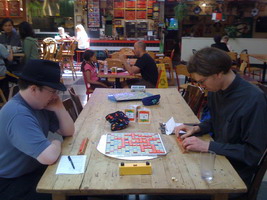
Where: Third Place Commons
Lake Forest Park Towne Centre (upper level)
17171 Bothell Way NE
Lake Forest Park, WA
(at the junction of Ballinger Way and SR522/Bothell Way NE)When: Games start around 2 pm (and go until everyone leaves or they close at 8pm).
Once a month, this is advertised as part of SCRABBLE® Meetup.What: Bring your own equipment (boards, tiles, clocks, score sheets, writing implements). No fee for playing these games! Who: Usually about 6-10 people show up (many of them regular Seattle Scrabble club members). All players are welcome! 1st & 3rd Friday Evenings: at Fado Irish Pub in downtown Seattle, starting at 6 PM. These gatherings are limited to the Collins dictionary, but they need not be limited to regular Scrabble. There could well be participants eager to play denscalating Clabbers, or if we have an odd number, perhaps some would choose to play anagrams. It's all about having a good time and celebrating the international lexicon. Organized by long-time Seattle clubmember Walker Willingham.
The following are more "casual" play get togethers. Note, we DO NOT organize these other sessions, so we don't know if they actually meet as listed. We just put this information here as a courtesy, so you probably want contact them to see if they are meeting before you go:
[ Return to Top ]Thursday afternoons: Shoreline-Lake Forest Park Senior Center (18560 1st Ave. NE #1, Shoreline) 12:00 to 4:00pm. Very casual, recreational group. Some use clocks, some don't; some play by the tournament rules, some don't. Play 2, 3-person games. Fee $4.
Center Director: Bob Lohmeyer, shorelinesc@seniorservices.org, (206) 365-1536
Article mentioning this club published in Shoreline Area News, March 2020Page 2 Books in Burien hosts a monthly Game night. These have been on Friday, but contact them for specific dates.
457 SW 152nd St.
Burien, WA 98166
206-248-7248SCRABBLE® Française: A small group meets the first Friday of every month at 7:00 PM and the third Saturday at 10:00 AM at the Alliance Française de Seattle, Suite 205, The Good Shepherd Center, 4649 Sunnyside Avenue North. Note that Suite 205 is the official address of the AFdeS, but actual meeting room varies. Often they meet in the library, which is kitty-corner across the hall, but it should be obvious where they are. Also, there are two parking lots on the property. No fee for playing these games--and they provide equipment. For more info, contact Bob Mauritsen.
"Game Nights"
Several bars, pubs, and coffee houses in the area have a "Game Night" where they encourage patrons to come and play various board games or quizzes (sometimes folks play SCRABBLE®). Here are some we've heard of (these tend to change, so contact the venue for more details).
- Mulleady's Irish Pub & Restaurant in Magnolia has "Board Game Night" every Monday.
- Wayward Coffeehouse in Greenwood encourages board game players 2nd and 4th Fridays.
CLUB PRIZES, STATS, HISTORY, ETC.
What's the "Bingo Bonus"? What's the "Category Word"? Are there other prizes?
Note: the prize moratorium began with the 7 October 2014 club session. From that point on, the only prizes that will be given out will be just $1 for each Category word. In March 2015, we evaluated the club's cash flow to determine if we could afford to give out any other prizes and at that point decided to continue with just the $1 category prizes, but also stop charging the Statistician (Ken) and Director (Rebecca) weekly club fees. This allows the club to remain in a positive cashflow situation.
In June 2015, we will look again at the club finances and discuss how monies in excess of the club expenses and reserves should be spent. Some possibilities: subsidize a celebration in honor of the 30th year of the club, add some weekly prizes, etc.
As of August 2018, we have stopped giving out any cash prizes. Also, Club Statistician (Ken) and Director (Rebecca) will pay a reduced ($4) fee.We give out several prizes during the evening.
For the first three games a Category is chosen and whichever play best fits the category wins the prize. Sometimes the category is a theme (e.g., "Halloween", "sports", "food", "things that are yellow", "something you wouldn't want to find in your house", etc.), other categories are for the highest scoring play of certain type: "high Q", "high out-play", etc.
The Bingo Bonus is awarded to someone who plays 3 bingos in a row in a game (Blue Card players only have to get 3 bingos in a game). [Note: until a player has an established club average (i.e., has played at least 9 club games), the Bingo Bonus is only awarded for 3 bingos in a row in a game.]
Category word: $5 75+ non-bingo: $1 100+ play: $1 500+ game: $1 600+ game: $2 700+ game: $5 + the undying awe and respect of your peers Bingo Bonus: $5 [Blue card*: 3+ bingos in a game; white card: 3+ bingos in a row] *Note: if you are playing White Card, but your average is below 365, then you just need to get 3 bingos in a game--not 3 in a row.
[ Return to Top ]
Even though I have no way of knowing this without attending, I somehow feel compelled to ask about "cards." Would you please explain "cards" to me?
Our club pairings are based on a tier system. Blue cards are for members who average under 365 points a game (based on a twelve-game average). White cards are for members who average at least 365 points a game. Members who average under 365 points a game may choose to "play up" by having "white card" people as opponents, but "white card" people may not elect to play blue card people for the rest of the evening: it makes the blue card people kittenish. The first game is not subject to pairing, so you'll see blue card and white card people play each other then.
Average score is computed for the calendar year, and starts over January 1st. You can find your average (and that of anyone else who has played at least 12 club games) on our Stats Page.
Cutoff history: it was 350 until 2002 or 2003, when it was raised to 360.
[ Return to Top ]
The next change was February 2006, when it was increased to 375 (in anticipation of higher scores with the addition of QI and ZA to the word list).
The most recent change (from 375 down to 365) became effective 1 January 2007.
I think I might get thrashed if I attended your club for the first time. What pointers could you give me that will give me some initial preparation?
I will gently tell you that each of us has sustained horrible losses, and our psychological scars from our early SCRABBLE® Brand crossword game club sessions have healed. You're not an idiot if it takes a while for you to actually win a game, but you might be one if you try to tackle our experts the first time you encounter SCRABBLE® play outside of "kitchen table play", expecting to beat them. I suggest asking each regular club member how long they have been playing, and how they improved.
To make it easier on your first time at club, we give you word lists (you can use them during play on your first night, and future sessions until you win a game at club). You also get free challenges and there are no overtime penalties your first time.
See our New Player Info page for an overview of the basics of club. We also have a One-Page Rules Summary [pdf] that will get you started.
In addition, we like to help prepare first-time visitors by offering them the following "cheat sheets":
- two-letter word list, including definitions, maintained by Rick Wong;
- three-letter word list, including definitions, also maintained by Rick Wong.
Check out our Study Tools Page for LOTS more study tools and links to word lists.
[ Return to Top ]
What are the Club Stats?
The score cards you fill out each night are sent to our Statistician, who enters all the game results, high scores, triple-triples, etc., into a stats program that generates the summary for each club night, and the updated standings for the year. Data that are posted include: average score, average spread, average number of bingoes, average score of your opponent, average number of bingos by your opponents, etc.
[ Return to Top ]
Our Statistician is Ken Clark (he took over at then end of August 2011). Filling out your card legibly, with the date and full names of your opponents makes his job easier. You might want to let him know how much you appreciate the work he does for us every week.
From June 2007 to August 2011, our Statistician was Mike Frentz. From January 2006 to June 2007, our Statistician was Doug Kruyt. Even though Doug was not able to make it to club much, he still did our stats every week. Not only that, but since Doug travels for work he often had his wife scan the score cards and email them to him so he could do the stats on his laptop computer on the road! Talk about dedicated. But all good things must come to an end, and Doug is happy we've found a replacement.
Our Statistician Emerita is Christina O'Sullivan. She did the stats for club every week for 7 years(!), for which we are very grateful. Next time you see her, why not share some appreciation?
Before Christina, Ken Clark did the stats. All statisticians have used (and continue to use) the PC-based Focus program created by Steve Oliger. Thanks Steve!
Do you people have an organizer or director or something?
Jane Bissonnette has been organizing and directing club sessions since club restarted in-person sessions in October of 2024, at our new location in Woodland Park.
Our previous club director Rebecca Slivka still updates the club website.
Jane Bissonnette passed the director's test in 2006 and began directing one-day tournaments for the club in 2007.
Lynn Dreyer is our most recent member to become a director. In the fall of 2008, Lynn started an official SCRABBLE® club in Tacoma (Tacoma club is defunct since Lynn moved to Seattle in early 2014). Ken Clark (one of the club's founding members) directs club sessions on a fill-in basis.
Lynn Dreyer directed the 2011 Emerald City Tournament November 11-13th.
[ Return to Top ]
Can you tell me some Club History?
The club was started in August 1985. The founding directors were Ann Ferguson and Mark Oppenheimer. Ann's mother, Bess Warren, and Ken Clark were the first people to attend. Starlite Clark and Julie Lopez became directors in 1998-1999(?). Rebecca Slivka has been the club director since January 2001, but stopped directing club sessions after the COVID lockdowns/club hiatus starting in March of 2020. Jane Bissonnette has been organizing and directing in-person club sessions since they restarted in October 2024, at our new Woodland Park location.
COVID hiatus: The last club session was 10 March 2020, before club went on indefinite hiatus during the COVID pandemic. With the resumption of in-person club sessions on 3 October 2024, we have a new location Woodland Park Lawn Bowling Clubhouse and a new day of the week: Thursday. Jane Bissonnette will be directing club sessions starting in October 2024.
We'll miss Mike Frentz, who was our Club Statistician from June 2007 to August 2011, and helped direct tournaments starting in January of 2008 (after passing the director's test in 2007).
Club Fee is currently $10 per week. We had raised the rate by $1 in August 2018, but then our rent went up, so we increased it to $10 in late February 2019 to cover the difference. Before then: the weekly session rate went up one dollar, to $7 per Tuesday, on 17 October 2017. The last previous increase was on 6 July 2010, when the weekly session rate went up one dollar, to $6. For more info, see the News page.June 2004, club moved from Fare Start Restaurant (previously called "Common Meals") to University Friends Meetinghouse.
Last held in 2003, the Northwest Bookfest provided booth space for the Scrabble Club every year. This was a great recruiting tool for the club. We miss Bookfest and hope it will return some day.
Tournament History:
[ Return to Top ]
- First tournament held in 1988. Tournaments held every year since then (except skipped 1993)
- 1995 was the 7th tournament
- 199?-2004 tournament held at Silver Cloud Lake Union (max number players 60)
- 2005 tournament moved to Red Lion 5th Avenue. 109 participants makes 2005 the largest ever.
- 2006 tournament was also held at the Red Lion, with 102 players.
- 2007 first one-day tournament Feb 3rd. Jane Bissonnette continues to direct more one-day tournaments.
- 2011 will be the 22nd Emerald City tournament.
WORDS, WORD LISTS, RULES, ETC.
OWL4 = OTCWL2018 went into effect 1 March 2019. Information on this page may not be updated to include the new words.
Look for +OWL4 which indicates that the list/link has been updated to include the new words.
OWL3 = OTCWL2014 goes into effect 10 April 2015. Information on this page may not be updated to include the new words.
For printable word lists and cheat sheets using the new words, please visit the Study Tools page.
Look for +OWL3 which indicates that the list/link has been updated to include the new words.What are all the acceptable* 2-letter words? +OWL4
	AA	AT	ED	FE	IT	MU	OM 	QI	UP
	AB	AW	EF	GI	JO	MY	ON	RE	US
	AD	AX	EH	GO	KA	NA	OP	SH	UT
	AE	AY	EL	HA	KI	NE	OR	SI	WE
	AG	BA	EM	HE	LA	NO	OS	SO	WO
	AH	BE	EN	HI	LI	NU	OW	TA	XI
	AI	BI	ER	HM	LO	OD	OX	TE	XU
	AL 	BO	ES	HO	MA	OE	OY	TI	YA
	AM	BY	ET	ID	ME	OF	PA	TO	YE
	AN	DA	EW	IF	MI	OH	PE	UH	YO
	AR	DE	EX	IN	MM	OI	PI	UM	ZA
	AS	DO	FA	IS	MO	OK	PO 	UN
*according to the Official Tournament and Club Word List, 2014 Edition (aka OWL3), effective 10 April 2015.
Check out our Study Tools Page for more tools and links to word lists.
The Collins/SOWPODS/CSW word list has an additional 19 acceptable two-letter words:
CH DI EA EE FY GU IO JA KO KY NY OB OO OU ST UG UR YU ZO
Tell me about the new word list (OWL3)?
Starting 10 April 2015, the official word list for North American SCRABBLE® club and tournament use will be the The Official Tournament and Club Word List, 2014 Edition (also known as OCTWL2014 or just OWL3). This update to the OWL adds 4 new 2-letter words, 66 new 3-letter words, 184 new 4-letter words, 465 new 5-letter words, etc., (over 9,000 new words!).
For lists of the new words, cheat sheets you can print out, ERRATA, etc., check out the OWL3 Transition section on our Study Tools page. Word lists and links on our Study Tools are marked with +OWL3 to indicate they have been updated to include the new words.
Tell me about the new word list (OWL2)?
Starting 1 March 2006, the official word list for North American SCRABBLE® club and tournament use will be the The Official Tournament and Club Word List, 2nd Edition (also known as OCTWL2 or just OWL2). This update to the OWL adds 5 new 2-letter words, 44 new 3-letter words, 128 new 4-letter words, 303 new 5-letter words, etc., (over 10,000 new words!).
For lists of the new words, cheat sheets you can print out, ERRATA, etc., check out the OWL2 Transition section on our Study Tools page. Most word lists on our Study Tools have been updated to use OWL2.
OWL3: The next update to the word list (OWL3/OTCWL2014) will be effective for tournament and club play starting
[ Return to Top ]1 December 201410 April 2015. See: Study Tools page for OWL3 Transition Word Lists and links.
What word source do you use?
North American SCRABBLE® clubs and tournaments use The Official Tournament and Club Word List, a lexicon used from five U.S.A. (no Canadian) English-language abridged dictionaries. This word source is available only to members of the National SCRABBLE® Association. This book no longer contains word definitions, but does contain all valid root words of up to nine letters in length and their extensions.
On 24 June 2014, NASPA announced (on Facebook) that the new word list, OWL3, will be effective for tournament and club play starting December 1st. The release date is scheduled for August 11th at Nationals, and NASPA will be selling the hardcopy there (in Buffalo). For those not attending Nationals, John Chew said: "the word list will be available for sale through our [NASPA] website by the end of August." An update to Zyzzyva should be available shortly after Nationals, as well.
NASPA Dictionary Committee had announced that the next update (OWL3) would be available in 2013, but that obviously is not happening. The best guess for the next update is sometime in 2014 or 2015, but there is no information available now.
With the demise of the National Scrabble Association (effective 1 July 2013), the printed Official Tournament and Club Word List is now only available to NASPA members and must be ordered by phone from Merriam-Webster (1-800-828-1880). It is not clear if the Long List is still in print or available.
If you don't need a printed version, your best bet is to download Zyzzyva or use one of the other digital study tools that has the word list.
You can order online at Word Gear (click on "Books"). By mail, send $19.20 ($14.95 + $4.25 shipping), specifying NSA membership number, to:
NSA Word Gear
P.O. Box 2113
403 Front Street
Greenport, NY 11944
(631) 477-0033For words longer than 9 letters, the NSA publishes the "Long List" (compiled from Merriam-Webster's Collegiate Dictionary, 10th edition). This can also be purchased online at Word Gear. [Note: plans to update the Long List are still in progress. The NSA has not yet announced which word source will be used for Long Words after the OWL2 is adopted, so at this point we're assuming the current LL, but they may also add the MW11. Waiting for official word from NSA.]
NOTE: Starting 1 March 2006, the official word list for North American SCRABBLE® club and tournament use will be the The Official Tournament and Club Word List, 2nd Edition (also known as OCTWL2 or just OWL2).
For lists of the new words, cheat sheets you can print out, ERRATA, etc., check out the OWL2 Transition section on our Study Tools page. Most word lists on our Study Tools have been updated to use OWL2.
[Note: plans to update the Long List are still in progress. The NSA has not yet announced which word source will be used for Long Words after the OWL2 is adopted, so at this point we're assuming the current LL, but they may also add the MW11. Waiting for official word from NSA.]
Check out our Study Tools Page for more tools and links to word lists.
OWL3: The next update to the word list (OWL3/OTCWL2014) will be effective for tournament and club play starting
[ Return to Top ]1 December 201410 April 2015. See: Study Tools page for OWL3 Transition Word Lists and links.
OSPD4, OSPD3, TWL98, OWL, OWL2, LWL, SOWPODS--what are all these?
OWL3: The next update to the word list (OWL3/OTCWL2014) will be effective for tournament and club play starting
1 December 201410 April 2015. See: Study Tools page for OWL3 Transition Word Lists and links.North American SCRABBLE® clubs and tournaments use The Official Tournament and Club Word List, also called the OWL (Official Word List). The Official Scrabble Player's Dictionary (OSPD) is used for School and Recreational play only. The newest (red) OSPD (OSPD4) came out June 2005; the corresponding update to the tournament list, OWL2, was published in early 2006 and became the official word source March 1st, 2006.
OWL/OWL1 = "Official Word List" and TWL98 = "The Word List 1998" both refer to the same thing, The Official Tournament and Club Word List authorized by the North American SCRABBLE Players Association for adjudication of challenges in club and tournament play. This list was updated in 1998. It contains words from 2-9 letter long (and their extensions).
OWL2 is the most recent edition of The Official Tournament and Club Word List that went into effect March 1st, 2006. It is the word list currently being used in club and tournament play.
See What word source do you use? for info on purchasing OWL2.LWL = "Long Word List" was published in 2004(about) and contains words 10-15 letters long. It is being used (along with OWL2) to adjudicate club and tournament play. No new update is expected any time soon.
OSPD# = "Official Scrabble Player's Dictionary, #th edition". OSPD is the "Official word source for Recreational and School Use". OSPD2 is very old. OSPD3 is equivalent to OWL1/TWL98 EXCEPT that about 200 "offensive" words that ARE in OWL/TWL98 were REMOVED from OSPD3. These were/are STILL in OWL/OWL2 and are valid in club and tournament Scrabble. I won't go into detail here, but suffice it to say that NSA succumbed to the pressure of censorship and removed some words.
Another difference between OSPD and OWL is that OWL has words 2-9 letters long (and their inflections), wherease OSPD has words 2-8 letters long (and their inflections).
OSPD4 was published in June 2005. OWL2 and OSPD4 are comparable (like OSPD3 and TWL98), except that not only have some few hundred "offensive" words been once again omitted from OSPD4, but there are also another hundred or so trademark words and other words that were not in the first printing of OSPD4 but ARE in OWL2 (see expurgated word list for words acceptable for club & tournament play that are not listed in the OSPD4).
Note also, that OWL/OWL2/TWL98 are all just WORD LISTS, where words are listed strictly in alphabetical order--making it easy to find whether or not a word is listed. OSPD3/4 are dictionaries (albeit with limited definitions), but they group related words and inflections. It's handy to use OSPD4 to look up a word to find a meaning (as long as you aren't looking for an "offensive" word), but it is not valid for word judging at clubs/tournaments.
All these lists are used for play in North America. Most other english-speaking countries use a UK-based dictionary (used to be Chambers, now it will be Collins) for their word adjudication, and call their word list OSW = "Official Scrabble Words". There is a large overlap between OWL/OSPD and OSW, but significant differences (words that are in one but not the other). For international (read North America + rest of the world) tournament & club play, a merged OSW+OSPD = SOWPODS word list was created. A vote among NSA membership about 5 years ago on whether to switch from OSPD-based word list to SOWPODS was defeated. So, unless you plan on qualifying for the World Championships or playing outside of North America, you can stick to OWL. For more info on the "SOWPODS" debate, I suggest a google search.
If you are playing at (or practicing for) club and tournaments, then use the OWL. If you are playing with friends, just agree before you start the game which word list you will be using.
OWL3: The next update to the word list (OWL3/OTCWL2014) will be effective for tournament and club play starting
[ Return to Top ]1 December 201410 April 2015. See: Study Tools page for OWL3 Transition Word Lists and links.
What if my opponent plays something that I think is not really a word on the board? Can I challenge it? How?
OLD way: Raise your hand and call "CHALLENGE!" An accredited Word Adjudicator hastens to your side to rule on the play, deeming it acceptable or unacceptable after consultation of the The Official Tournament and Club Word List. Of course, if you still are not satisfied with the rule (perhaps the adjudicator is drunk or insane or has poor reading comprehension skills), you may request a second opinion. If one word of the play has over nine letters, the Long List may be used as a word source.
New way: After you say "challenge" and neutralize the clock, you and your opponent put your tiles face down on the table and walk over to the Word Judge Computer. The player challenging the play types in ALL the words being challenged, then the player being challenged presses the Judge (TAB) key. Thanks to Michael Thelen for creating Zyzzyva - a great program both for study and word adjudications.
If you're not sure if you want to challenge or not, you can say "HOLD!" which prevents your opponent from drawing new tiles while you think about whether or not to challenge. You might want to put your hand on the tile bag to make sure your opponent understands you are holding their play. To release a hold, say "I accept the play".
Detailed rules are spelled out in the Official Tournament Rules.
[ Return To Top ]
What is a Word Judge? How can I become one?
There is a formal procedure for adjudicating challenges (see What if my opponent plays something that I think is not really a word?). Only the Director, or designated staff, or an authorized computer program may rule on the validity of a challenged play. The guidelines for acting as word judge are detailed in the Official Tournament Rules.
If you want to become an authorized word judge, familiarize yourself with the rules regarding Adjudicating Challenges Manually then take the Word Judge test (ask your director).
Note: with the advent of Adjudicating Challenges by Computer [a.k.a. "Software Self-Lookups" or SSL], unless there is a power failure the only time you'll see a human word-judge is to facilitate players with mobility issues who can't easily get up and go to the computer.
[ Return To Top ]
What Rules do you follow?
Clubs and tournaments use the Official Tournament Rules of the North American SCRABBLE Players Association. These rules are essentially just an extension and refinement of the rules that come in your typical SCRABBLE® game; they detail specific procedures for drawing tiles, scoring, challenging, using clocks, handling overdraws, etc.
You are responsible for reading, understanding, and following the Official Rules during Tournament and Club play. You can review them online any time, or print out a copy for yourself.
With the changeover from NSA to NASPA, the NSA Policy on Disruptive, Intimidating and other Unacceptable Behavior has been replaced by the NASPA Code of Conduct.
History of Rules changes:
[ Return To Top ]
- 2012 June 27 - Several changes
- 2011 June 16 - Several changes
- 2010 February 2 - A few changes
- 2009 August 1 - Minor revision
- 2009 February 1 - Major rewrite and reorganizaion of the rules (with a minor change Feb 9)
- 2008 July 25 - Several changes [NSA]
- 2004 May 1 - some changes [NSA]
TOURNAMENTS, RATINGS, NSA, NASPA, ETC.
[ Return to Top ]NSA v. NASPA : What's the deal?
1 July 2013 News flash: NSA closing down, Hasbro takes NSA functionality inhouse. NASPA unchanged. More details on the News page.
Hasbro (owners of the SCRABBLE® game in North America) announced in 2008 that they would drastically reduce their funding of competitive Scrabble. As of January 1, 2010, Hasbro will no longer be providing regular funding to SCRABBLE clubs and tournaments.
As a result, over the course of 2009, the National SCRABBLE® Association (NSA) will transfer responsiblity for clubs and tournaments to the newly formed North American SCRABBLE® Players Association (NASPA), leaving the NSA to concentrate on "developing new markets for SCRABBLE in areas such as School SCRABBLE."
The transition from NSA to NASPA has already started, with new membership requirements and fees kicking in starting 1 July 2009. The NASPA is making these changes to generate new revenue to replace that lost by the lack of funding from Hasbro. Some of the changes announced are:
- Annual Player membership fee in the NASPA will be $30 (up from $20/$25 in the NSA). The memberships are good for calendar year (Jan 1-Dec 31), but they are trying to soften the blow by making the initial NASPA membership good until the end of 2010.
- NASPA membership is required to compete in NSA/NASPA tournaments starting July 1st. NOTE: From now until July 1, you have to be either an NSA or an NASPA member to compete in tournaments--so if your NSA membership is about to run out, you only need to join the NASPA from now on.
NASPA update 30 March:
Memberships purchased on or before December 31, 2009 have an extended initial term: your membership will be valid from the receipt of your dues through December 31, 2010. After that, each membership term is up to one calendar year (from January 1 through December 31).
- The old Tournament rating fees will be replaced by a "Tournament Participation Fee". The existing fee structure is a fixed amount per player per tournament ($1 per player per Local Club tournament, $1.50 per player for an open-rated tournament with 16 games or fewer, and $1.75 per player an open-rated tournament with 17 games or more). The new fee will be $.50 per player per tournament game.
For example a one-day 8 game tournament under the NSA would cost $1.50 per player; but the new fee will be $4.00 per person. A three-day tournament with 20 games would cost $1.75 per player under the old system, but $10 per player with the new one. Players should expect that tournament entry fees will be raised and/or prize payouts will be reduced to accommodate this change.
- Annual $30 fee for NASPA sanctioned clubs (also due starting July 1st). Also, Directors must be current members of NASPA for their clubs to retain active, sanctioned status.
What does all this mean for you?
Well, if you just come to club you shouldn't notice any change. We have enough money in our club fund to cover the annual sanctioned club fee so that is no problem. If you attend tournaments, expect to pay a little more for your NASPA membership (sign up by July 1st for the best deal to start with!), and expect to pay $5 to $10 more for every tournament you enter.For the latest info check out the NASPA website: www.scrabbleplayers.org.
Note: it might take a while for this website to be updated to change all the "NSA" references to "NASPA", where appropriate. Links to information currently on the NSA website will be changed to the relevant location on the NASPA website as the transition progresses. It's gonna be a while, so look at NASPA website for the final word.
What is WGPO?
Several players dissatisfied with the North American SCRABBLE Players Association (NASPA) announced in January 2010 that they were starting up an independent player's organization. The name of the new organization is Word Game Players Organization, or WGPO.
In March 2010, we posted a news item about WGPO giving a brief overview of the issues/status at that time. The issues behind the schism include concerns about how NASPA is governed, communication issues, increased cost of tournaments, and how NASPA income is spent.
Since then, WGPO has become more organized. They launched a website, announced and voted on bylaws, and have started to rate their own tournaments. Visit the WGPO website for more background. You can also get the latest updates by joining the WGPO Yahoo discussion group (note: you don't have to join WGPO to join the discussion group).
What does this mean for you as a SCRABBLE® player?
If you are just attending club, there isn't any impact. As far as tournaments go, some directors have announced they will be running their tournaments under the auspices of WGPO instead of NASPA. They are currently still using NASPA rules, so the only difference so far is that WGPO is doing the rating (so you'll have a separate rating from your NASPA rating), and WGPO is not charging a rating/participation fee.
All upcoming Seattle tournaments will be NASPA sanctioned and rated.You mentioned the National SCRABBLE® Association. Do I need to become a member?
No. If you want to play in tournaments, then YES, you'll eventually need to become a member of the NSA. However, you can wait until after your first tournament to become a Member of the National SCRABBLE® Association. For U.S. residents, the membership dues are $20 per year. With membership you receive the most recently edited version of a national club list, Official Tournament Rules, and a one-year subscription to the SCRABBLE® News.
You can also register or renew your membership online.
NO. However, effective 1 July 2009, players must be NASPA members to compete in NSA/NASPA sanctioned tournaments. [NOTE: until July 1, you have to be either an NSA or an NASPA member to compete in tournaments--so if your NSA membership is about to run out, you only need to join the NASPA from now on.]
Annual Player membership fee in the NASPA is US $30.
Memberships purchased on or before December 31, 2009 have an extended initial term: your membership will be valid from the receipt of your dues through December 31, 2010. After that, each membership term is up to one calendar year (from January 1 through December 31).Find a printable NASPA membership form and online payment options at the NASPA Membership page.
For more info about transition from the NSA check the NASPA website FAQ page.
[ Return to Top ]
What about tournaments?
To become a rated player, you must play in an NASPA-sanctioned tournament. You must be an NASPA member to compete in sanctioned tournaments. You can find a list of all NASPA-sanctioned tournaments in North America by looking either on the NASPA website or on cross-tables.com.
The Seattle Club usually hosts one multi-day tournament a year. Previously it has been held over Memorial Day Weekend, but starting in 2010, it will be on the Veteran's Day/Rememberance Day holiday. Read all about it on our Emerald City Tournament Page.
Starting in 2007, Jane Bissonnette has also been hosting single-day tournaments. You cand find complete details, including online registration, for the next one-day'er on our Tournaments Page.
Additionally, there are annual Club Challenge tournaments between the Portland and Seattle, and between Vancouver and Seattle. Check the Tournaments Page for details.
Look on our Tournaments Page for a list of upcoming tournaments in the neighborhood. You can also find a map-based view of upcoming tournaments on cross-tables.com.
[ Return to Top ]
How do ratings work?
You enter your first tournament as an "unrated" player. Your rating is computed based on your performance in an NASPA-sanctioned tournament (how many wins, ratings of your opponents). Here is a more detailed explanation: John Chew explains ratings.
Your rating is used to position you in subsequent tournaments. Some tournaments use ratings cut-offs to separate divisions (like our Emerald City tournament), others use fixed division sizes with people ordered by rating (like our one-day tournaments). You must have an established rating to play in the annual National Scrabble Championship Tournament—known in 2006 as the US SCRABBLE® Open—but all others are open to unrated players.
Just finished a tournament and want to know what your new rating will be? Use John Chew's New Rating Calculator. Remember that NASPA rates at most 16 games at a time, so if the tournament is longer than that they will split it up and rate it in two sections (e.g., our Seattle tournament of 20 games is rated as 1-10, and then 11-20)
What's the difference between a Local Club Tournament and an Open Rated Tournament?
The North American SCRABBLE Players Association sanctions two different types of tournaments: Open Rated Tournaments (ORT) and Local Club Tournaments (LCT). ORTs are fully rated, whereas LCTs are rated using 1/3 the value of an ORT. This means that your rating will only change by 1/3 as much in an LCT as it would in an ORT.
Each ORT must be approved by the NSA at least 8 weeks before it is held. There is no time restriction on LCTs.
[ Return to Top ]
What is a Director? How can I become a Director?
The Director is the person who oversees a club or tournament session and ensures that NASPA rules and procedures are followed. If you wish to run a sanctioned NASPA Tournament, start your own official SCRABBLE® club, or direct at an existing club or tournament, you need to become a sanctioned director.
To become a Director, you must first be a member of NASPA. You then need to follow the Director Certification process (order and complete the test, etc.) for approval.
Thoroughly review the Director's Manual and the Official Tournament Rules before taking the Director's Test.
SCRABBLE ONLINE...
Where can I play SCRABBLE® online? What is ISC?
There are numerous sources for Internet SCRABBLE® play:
The Internet SCRABBLE® Club - Most popular site for NASPA members (but lots of others play at ISC as well). Note: it's free to sign up and play on ISC, but if you become a supporting member you get some perks (see below). Also, you are not allowed to change your ISC handle (user name), so choose wisely.
If you play on ISC long enough, you are sure to encounter an opponent who accuses you of cheating, is a cheater himself, or is just an unpleasant jerk. Rest assured, that these people are relatively easy to avoid if you follow a few simple tips for enjoying your time on ISC:
- Only play people you know, or those who identify themselves as NASPA/NSA/tournament members (The antisocial jerks and cheaters usually don't identify themselves). You can view our Club Roster to see ISC handles of club members.
- Use the "finger" command (e.g, "finger slugbiker") to view a player's profile. The Finger command will show you whatever the player has posted in their finger notes, "amiability" rating, their unfinished games status, if they are a supporting member, etc. Be sure to identify yourself in your own finger notes, too.
- Avoid players whose "Number of Unfinished Games" is Medium or higher (this almost always indicates someone who will quit if they are losing), or whose "Amiability" is Low or Very Low (this usually indicates the player has been censored for abusive language).
- Use the "Buddy List" feature on ISC to keep track of people you want to play with
- Only play double challenge (single or void is not good practice for tournament or club play)
- Set the time for 20 minutes or less (since you aren't scoring, tracking or drawing tiles, this is comparable to 25 minutes in a "live" game)
- Become a "supporting" member of ISC (annual subscription of $29) to get more features (including: longer buddy list, saving and analyzing your games)
- Join the "TPG" (Tournament Player's Group) on ISC (available only to NASPA/NSA members) and then you can use the gseek TPG command to send a seek request to other TPG members only.
- You can set the Fair-Play Agreement to attest that you won't be using anagrammers or looking up words while you play, but seeing it set by someone else doesn't guarantee they won't cheat--just that they can't run Quackle, Zyzzyva, or other anagram/study programs while they play. And Mac users are unable to set FPA at all.
Finding players on ISC:
- Check out our Club Roster to see ISC handles of club members.
- ISC Facebook Group - unofficial site, created by players to keep in touch
- NASPA Facebook Group - some NASPA players have posted their ISC handles
Some other sites:
playsite[ Return to Top ]
The Pixie Pit
escrabble.com
How can I talk with other Seattle Club players?
In keeping with the times, we now have a Facebook group for the Seattle Club. If you are already a Facebook member, you can just join the Seattle Scrabble Club Group on Facebook.
We'll use the group as a way to advertise our club, and as another way for club members to keep in touch, post images, etc. Feel free to sign up, write on the wall, start discussions, and all the other Facebook-y things.
How can I talk with other SCRABBLE® players? What is CGP?
CGP is the nickname of the Yahoo Group "Crossword-Games-Pro" email list. If you join CGP, you'll get to exchange information with other competitive Scrabble® players, hear the latest gossip, find out about upcoming events, get study information, etc. As with any email bulletin board, passions can run high so tread cautiously and remember that lots of people read these posts. Sherrie Saint John is the organizer of the CGP list. To find out more about CGP (including how to join), please check out Sherrie's CGP info page.
Since late 2013, more discussions are taking place on various Facebook pages. Among them: NASPA on Facebook